
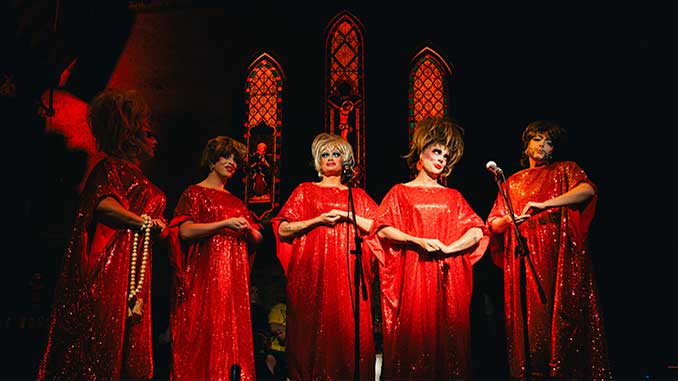
It takes months of unwavering dedication, love, and collective vision to breathe life into an empty shell, transforming it into a vibrant sanctuary for a marginalised community. Yet, it took mere days for the dream of the Divine Playhouse to be brutally dismantled, a stark reminder of the persistent forces that seek to silence queer voices and erase our spaces.
This week, the vibrant gothic signage and queer absurdist art that adorned the Divine Playhouse, a beacon of LGBTQ+ creativity, were unceremoniously stripped away. Volunteers, with heavy hearts, whitewashed a mural that had pulsed with the spirit of queer expression, a painful act of erasure mirroring the broader societal pressures we constantly face.
After a year of dormancy, Sydney’s St John the Evangelist church, deconsecrated nearly a century ago, had been reborn as an LGBTQ+ inclusive arts space. Opening its doors on July 8th with a year-long permit, Divine Playhouse was more than just a venue; it was a promise, a testament to the community’s resilience and its desperate need for belonging.
For a fleeting three days, Divine Playhouse flourished. It hosted an electrifying opening night, a riotous queer comedy show, and a joyous disco. It was a space where queer joy, art, and community could thrive, unburdened by judgment.
But this brief blossoming was met with immediate, visceral opposition. Religious groups, fuelled by a narrative of ‘hateful blasphemy,’ rallied outside, demanding the withdrawal of a $100,000 arts grant. Within days, the venue’s landlord, citing ‘offensive trade,’ ordered Heaps Gay Events to cease operations, swiftly terminating their lease. This wasn’t just a business dispute; it was a direct assault on queer existence and artistic freedom.
Heaps Gay was given a mere three days to vacate a space that had been months in the making, a cruel irony that underscored the fragility of queer spaces in a hostile world. Their legal team is now exploring avenues for damages and a sex discrimination claim, fighting not just for a venue, but for the fundamental right to exist and express without fear.
“This isn’t just about Divine Playhouse; it’s about censorship, about the systemic silencing of queer voices,” declared Kat Dopper, promoter and founder of Heaps Gay. “If we back down, these groups will only grow bolder, more powerful, and louder. We cannot, and will not, allow that to happen.”
‘Offensive Trade’: A Weapon Against Queer Expression
Nestled in the heart of Sydney’s central business district, the deconsecrated church had a history of transformation, serving as a children’s school and a theatre. Its latest incarnation as Divine Playhouse was meant to be its most radical and vital: a safe, inclusive, and unapologetically queer-friendly arts space, a sanctuary in a city that often struggles to embrace its diverse communities.
Its opening night, aptly named ‘The First Rite,’ was a celebration of queer artistry and community. Hundreds gathered to witness electrifying performances from drag artist Etcetera Etcetera, a pulsating DJ set by Stereogamous, and the iconic Sisters of Perpetual Indulgence. Deputy Lord Mayor Jess Miller spoke of the ‘intergenerational magic’ of such spaces, a magic now threatened by intolerance.
From the stage, Dopper revealed a last-minute name change from ‘Unholy Playhouse’ to ‘Divine Playhouse,’ a gesture of good faith made in response to concerns from the Christian community. This act of conciliation, however, proved futile against entrenched prejudice.
Despite this olive branch, Christian groups like Fit for the Kingdom and the Prodigal Sons converged in protest, decrying what they termed ‘hateful blasphemy that mocks what we hold most sacred.’ Their outrage, however, seemed to ignore the very real pain and marginalization experienced by the queer community.
Their ‘evidence’ comprised social media images from ‘The First Rite’: drag queens reimagining religious iconography, an attendee wearing a crucifix corpus as a choker, and a performer in a pig costume offering french fries as a playful take on communion. For many in the queer community, these acts are not blasphemy, but rather a reclaiming of narratives, a subversion of oppressive symbols, and a search for divinity within their own experiences.
A day after the celebration, the landlord’s lawyers issued a notice of breach, alleging ‘offensive trade’ had caused ‘grievance and disturbance.’ This archaic term, rooted in 19th-century English law, was weaponized to justify eviction under section 129 of the Conveyancing Act 1919 (NSW), exposing the vulnerability of queer spaces to outdated legal interpretations and moralistic attacks.
The building’s owners, Redevelop, founded by billionaires Anthony El-Hazouri and Charbel Hazzouri told the Sydney Morning Herald that they were “unaware” of the space’s intended use and deemed the events “equivalent to hate speech” for “targeting Christian beliefs.”
This narrative conveniently ignores the long history of religious institutions targeting and harming queer individuals, framing queer artistic expression as aggression rather than liberation.
Marque Lawyers, representing Heaps Gay, vehemently argues that the termination lacks a proper legal basis.
Michael Bradley, managing partner at Marque Lawyers, highlighted the absurdity of the ‘offensive trade’ clause, noting its origins in 1840s English law, historically used to regulate nuisances like ‘noxious smells.’ To apply such a relic to queer artistic expression is not only anachronistic but deeply discriminatory.
The Conveyancing Act’s definition, prohibiting ‘any noxious, noisome, or offensive art, trade, business occupation, or calling,’ was never intended to police morality or artistic interpretation.
“It has never been applied to moral offensiveness in the way the landlord is attempting,” Bradley asserted. “While the landlord may feel personally offended by Heaps Gay’s activities, that is a subjective personal opinion, not a legal ground for eviction.” This distinction is crucial: personal discomfort should not dictate public access or artistic freedom.
Macquarie University professor and land law expert Cathy Sherry underscored this point, stating there’s a ‘very strong possibility’ the definition refers to physically offensive elements, given ‘noisome’ and ‘noxious’ are physical descriptors. The attempt to broaden ‘offensive’ to include moral objections sets a dangerous precedent.
Sherry warned that allowing landlords to unilaterally define ‘offensive’ based on moral objections could push Australian property law towards a US model, where restrictive covenants historically facilitated racial segregation and discrimination. This chilling parallel highlights the potential for such interpretations to be used against any marginalised group, not just the queer community.
“If one landlord can evict a tenant based on their subjective moral offence, then every landlord can,” she concluded, emphasising the widespread threat this poses to artistic freedom and community spaces.
The Fight for Sanctuary Continues
In a statement, the Catholic group Fit for the Kingdom disingenuously claimed that Divine Playhouse organisers were not stopped from publishing or performing, yet simultaneously ‘welcomed the landlord’s decision to refuse to allow their premises to host hateful content.’ This contradictory stance reveals a desire to control narratives and spaces, rather than genuinely support freedom of expression.
A spokesperson for the group framed their ‘prayer vigils’ as acts of ‘public awareness’ against the ‘targeted ridicule of our Catholic faith.’ This narrative conveniently sidesteps the fact that queer existence and expression are often perceived as a challenge to conservative religious doctrines, leading to real-world harm and discrimination.
Their claim, ‘We don’t suggest the organisers or performers are less deserving of human dignity or safety, or target them as individuals,’ rings hollow when their actions directly lead to the closure of a safe space and the targeting of a community.
Before its premature closure, Divine Playhouse had already secured hundreds of bookings, poised to support over 1500 artists, producers, performers, technicians, small creative businesses, and staff. This wasn’t just a venue; it was an ecosystem of queer talent and livelihood, now disrupted by prejudice.
Should the landlords be found in breach of contract, Heaps Gay is prepared to claim substantial damages, a necessary fight for justice and accountability.
Lawyers are also exploring a complaint to the Australian Human Rights Commission, hoping for conciliation, though the deeper wounds of discrimination often require more than mediation.
If conciliation fails, Heaps Gay is ready to take the fight to the federal court, a testament to their unwavering commitment to justice.
While legal battles loom, the Divine Playhouse community is already searching for a new home, embodying the queer spirit of resilience and adaptation.
Over 18,000 allies have signed a petition, and $41,000 has been raised to cover artist fees, legal costs, and relocation expenses. This outpouring of support underscores the profound need for such spaces and the collective will to protect them.
“I’m heartbroken that so many won’t get to experience the magic of this space,” Dopper lamented, her words echoing the grief of a community denied its sanctuary.
“It was a true gem: a stage in the round for bands, a cabaret with sprawling catwalks, a theatre… it was, quite literally, perfect for us,” she added, painting a vivid picture of what was lost.
For days, a steady stream of volunteers and stakeholders have moved through the building, carefully rolling out speakers and placing commissioned artwork into storage, each action a quiet act of resistance against the forces that sought to erase their presence.
But Keekee James’s mural, a vibrant testament to queer artistry painted directly onto the walls, could not be saved.
“To paint over it feels like our own act of blasphemy,” stated Cecily Hardy, a Divine Playhouse representative. “Art has been censored throughout history, and this is our community’s painful encounter with that reality.”
Dopper reiterated that organisers were not mocking the church, emphasising their efforts to respond to community concerns and adjust their program. Their attempts at dialogue were met with condemnation, not understanding.
Tim Roberts, president of the NSW Council for Civil Liberties, powerfully asserted that regardless of intent, Australians must retain the right to critique and satirise powerful institutions. This freedom is especially vital for marginalised communities who often use art to challenge oppressive norms.
“If we cannot even playfully challenge a religion, that constitutes a profound silencing of our speech and public discourse,” he concluded, highlighting the broader implications for free expression.
While NSW Premier Chris Minns initially questioned the suitability of the location, other Labor MPs, including NSW Arts Minister John Graham and Stephen Lawrence, have since voiced their support for Divine Playhouse, recognising the importance of protecting queer cultural spaces.
Lawrence, who is openly gay and was raised Catholic, articulated a nuanced perspective: ‘Christians have the right to feel offended and to express that publicly. But we, as a society, must fiercely protect artistic freedom and ensure state grants uphold that principle.’ His words resonate deeply within the queer community, which often navigates the tension between religious freedom and the right to exist authentically.
In the face of adversity, Dopper is organising a fundraiser show for the displaced artists and a protest, scheduled for Saturday. These acts of collective defiance are not just about reclaiming a space, but about asserting the queer community’s unwavering right to joy, expression, and existence.
Rob is the founder of GTG. Launching the GTG-Sydney brand in 1995, it has gone from a VHS tourist guide for Sydney to a global phenomenon, partnering with Pride events and special events and charities all over the world, raising millions of dollars for the LGBTQIA+ communities and showcasing our big gay world to anyone who wants to join in the fun.
Rob is a trained marketer and journalist. An Emmy award winner, a NIDA-trained TV Presenter who has been on digital channels, cable and terrestrial broadcast television globally as a presenter, producer and creative.
He is currently editor-in-chief and producer of GTG and the co-host of The Unfashionably Late Podcast.